
By NAACP Chairman Leon W. Russell and Vice Chair Karen Boykin Towns,
National Board of Directors
February 17, 2026--Today, the NAACP mourns the passing of Rev. Jesse L. Jackson Sr., a transformative leader whose life’s work is deeply woven into the history, mission, and enduring impact of our Association and the nation.
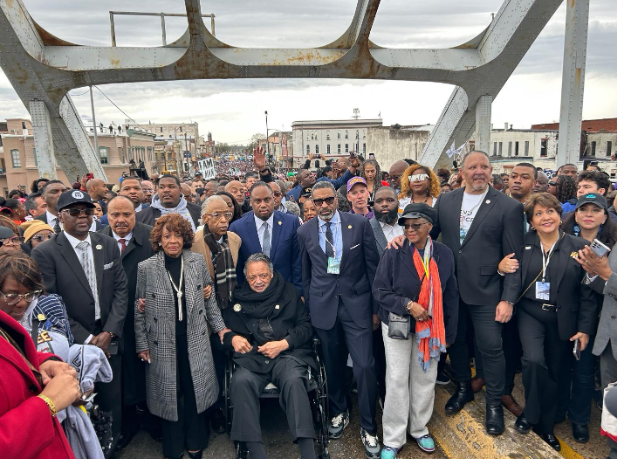
Rev. Jackson was family to the NAACP. From his early days as a young organizer in the 1960s to his historic run for the presidency in the 1980s, he worked alongside NAACP leaders, marched with our members, spoke at several of our national conventions, and helped expand the national movement for racial equality into a broad, people-powered coalition demanding systemic change.
A recipient of the NAACP President's Award in 1988 and the Spingarn Medal in 1989, he challenged this nation to live up to its highest ideals and inspired millions to join the fight for justice.
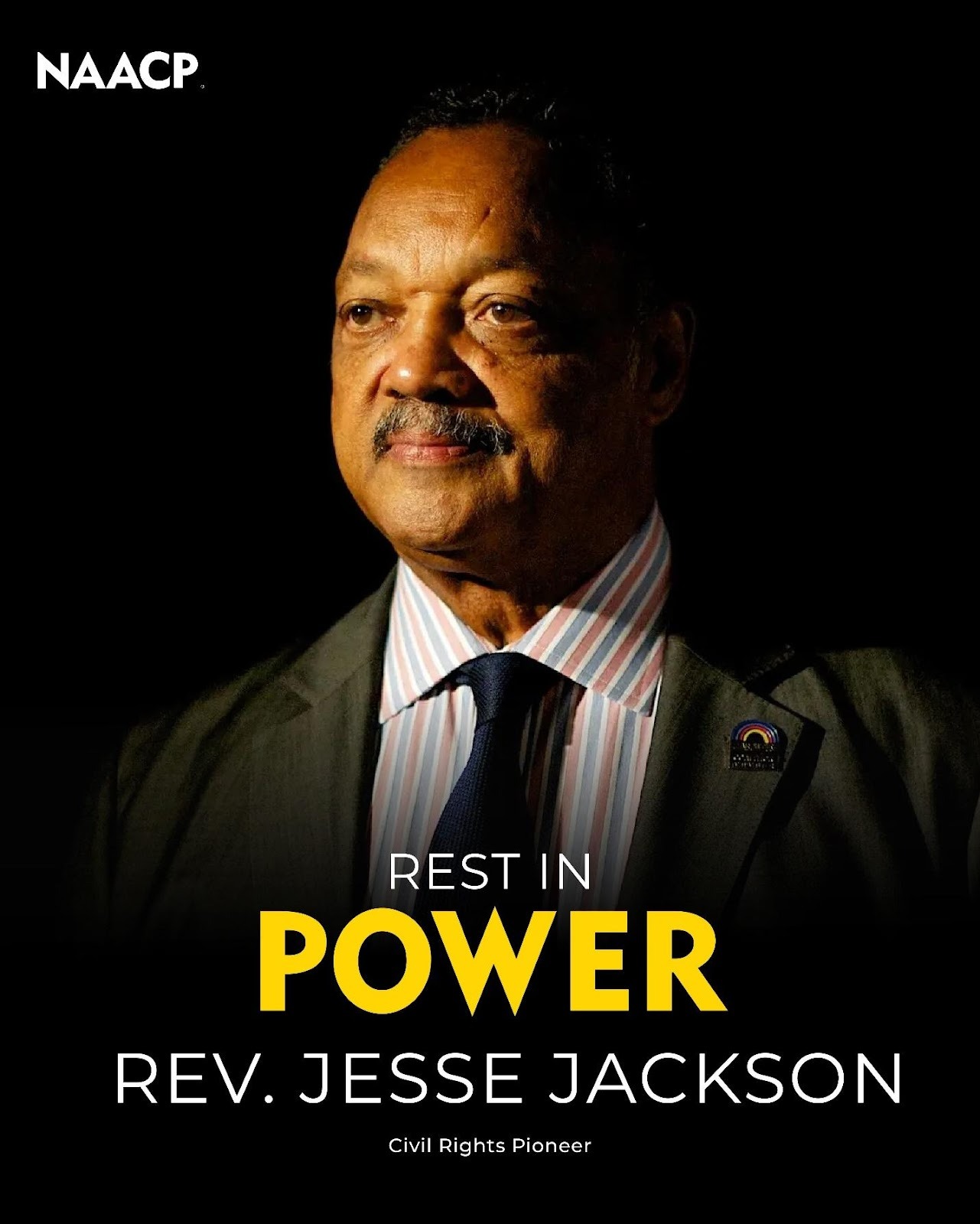
His leadership in advancing voting rights, economic justice, and educational opportunity strengthened the very pillars of our community. Whether challenging racially discriminatory policies, uplifting marginalized voices, or building multiracial movements through the Rainbow PUSH Coalition, Rev. Jackson’s work forged a path toward equality for all.
As we honor his legacy, we are reminded of what he taught us: that hope is both a strategy and a responsibility.
Let us carry his light forward by staying committed, staying organized, and remaining faithful to the pursuit of justice.
Rest in Power, Rev. Jackson.
Chairman Leon W. Russell
Vice Chair Karen Boykin Towns
National Board of Directors
Amalgamated Transit Union on the Passing of Civil Rights Icon Jesse Jackson, Sr.
Silver Spring, MD – Amalgamated Transit Union International President John Costa on the passing of civil rights icon Jesse Jackson, Sr.
"A friend of the ATU, Rev. Jesse Jackson, Sr., was a champion of labor unions and a strong advocate for affordable public transit for all. From marching alongside Dr. Martin Luther King Jr. to founding the Rainbow PUSH Coalition, he spent a lifetime on the frontlines of the civil rights movement. In his memory, we will continue his fight for economic and social justice, voting rights, opportunity, and democracy for all. Rest in Power, Brother!"
A Shepard of Black Political Power
On Jesse Jackson, Black political power, and insistence that turned protest into possibility.
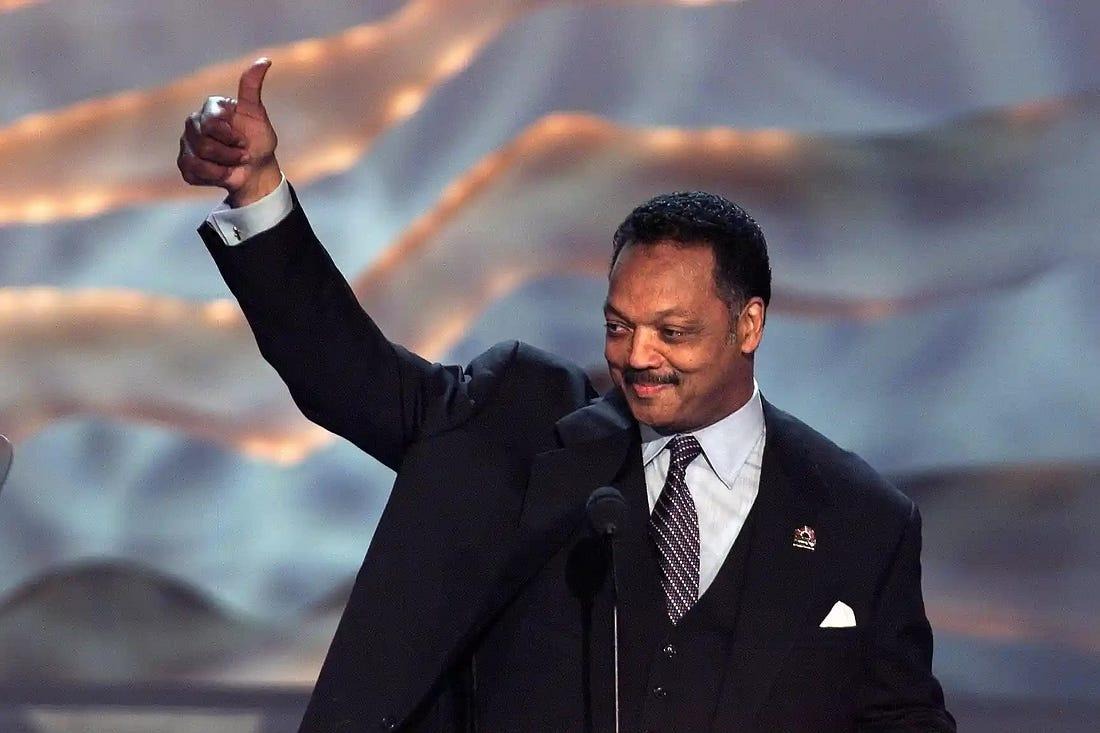
Reverend Jesse Jackson/Courtesy photo
By Frederick Joseph
The first text I saw this morning, the one that told me Jesse Jackson had died, came from my mother.
There was no paragraph. No reflection. No explanation. Just a photograph of him and a text bubble that simply said: RIP.
I do not know that my mother and I have ever sat down and had a formal conversation about Jesse Jackson. I am certain his name has drifted through the house over the years, mentioned in passing, folded into the larger weather of politics and church and memory. But with that photo, she did not have to say anything else. She did not have to explain who he was or why he mattered. The image was enough. Of course I should know who he is automatically. Of course most Black people should know who he is automatically. That is the measure of the man. He was not trivia. He was atmosphere.
You cannot have a conversation about modern Black political power without saying the name Jesse Jackson.
To attempt it would be like telling the story of a river while pretending not to see the bend that helped change its course. He stood beside Dr. King in the 1960s, yes. That is the photograph most people remember. But what distinguished him was not proximity to greatness. It was his refusal to let that greatness calcify into nostalgia. He would not allow the movement to become a museum piece. He carried its fire out of the streets and into the arena of national power, where fire is far less welcome.
He built organizations. He ran for president when the idea of a Black man doing so seriously was treated as even more of a fantasy or threat. And in doing so, he forced this country to confront a simple fact: we were not petitioning to be included as guests in someone else’s democracy. We were insisting on being recognized as stakeholders in a nation built in no small part by our labor and our blood.
For many Black Americans, he represented something deeply personal. He represented audacity. He represented the belief that our lives, our votes, our labor, and our dreams were not marginal but central to the American story. When he ran in 1984 and 1988, he did more than campaign. He altered the psychological landscape. In living rooms and barbershops and sanctuaries, people who had been told all their lives to lower their expectations watched a Black man compete on a national stage not as a symbol but as a strategist. That shift cannot be quantified in polling data. It can only be measured in the quiet recalibration of possibility inside the minds of children and their parents.
He spoke the language of hope, but it was not a decorative hope. It was not the kind that fits neatly on a bumper sticker. It was organized hope. It was hope that demanded policy, demanded budgets, demanded accountability. He believed poor people deserved power, not pity. He understood that racism, militarism, and economic exploitation were not separate afflictions but braided together in the architecture of the nation. And he said so plainly, even when plain speech cost him favor.
There will be, as there always is, an effort now to smooth him out. To reduce him to a few agreeable phrases. To remember him in ways that do not trouble anyone’s conscience. But Jesse Jackson was never meant to be harmless. He was imperfect. He was controversial. He was human. And yet he was also a bridge between the era of marching and the era of governing, between the pulpit and the ballot box. He helped transform protest into infrastructure.
My mother did not have to write an essay in her text message. She did not have to explain the stakes. The photograph was enough because his life had already done the explaining. It had already imprinted itself on a generation that understood, without rehearsal, what he meant.
To many of us, his life was a reminder that progress is not gifted. It is insisted upon. It is insisted upon by those willing to risk ridicule, willing to endure contradiction, willing to stand in rooms that were not built for them and refuse to leave quietly. His passing closes a chapter, but it does not absolve us of the work that chapter demands we continue.
The photo was enough. The name is enough. And the insistence he embodied remains.
Rest in power, Rev. Jesse Jackson.
Reverend Jesse Jackson: He Cared for Us All
By Dr. Juan Andrade, Jr.
President
United States Hispanic Leadership Institute, Inc.
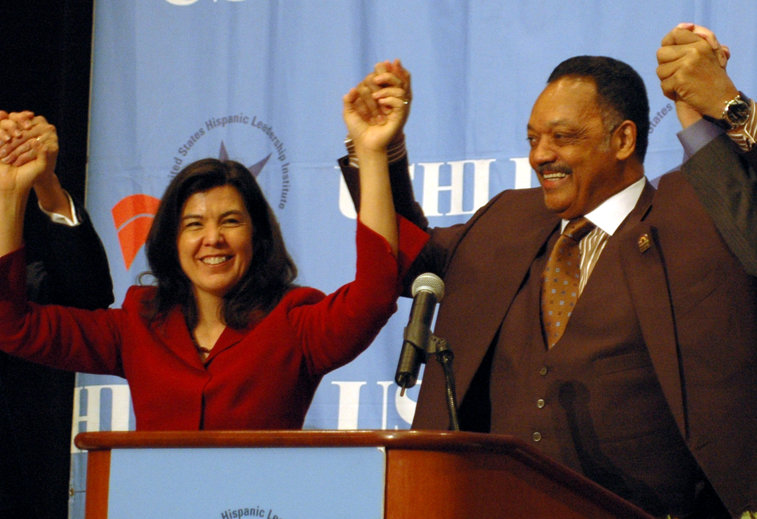
USHLI and Rev. Jackson joined forces numerous times over the past 40 years. We marched together in Chicago, Atlanta, California and South Carolina always advocating for voting rights and/or worker rights. He spoke several times at USHLI's national conference. I spoke at the Rainbow Push national conference. We both spoke at a leadership conference at the UN in New York, at a Labor Solidarity rally in Washington, DC, and at an anti-war rally in Chicago.
He always spoke about US, we the people. He stirred the conscience of the nation during his two presidential campaigns. When the left wing and right wing of the Democratic Party couldn't unite around a presidential nominee, he reminded the party that it takes two wings to fly. He advised Blacks and Whites to learn Spanish to bring more people in under the same tent. He was many things to many people, but what he was to everyone was Inclusive.
Those of us who were fortunate enough to know him and to learn from him should remember and share what we learned in honoring his legacy. He changed America and much of the world for the better and everyone who can should continue his work.
Rep. Cleaver’s Statement on the Passing of Civil Rights Leader, Reverend Jesse Jackson
February 17, 2026--Today, U.S. Representative Emanuel Cleaver, II (D-MO) released the following statement on the passing of Reverend Jesse Jackson.
“I am deeply saddened by the passing of my dear friend, Reverend Jesse Jackson.
“For decades, Reverend Jackson served as the head of Operation Breadbasket – a program of the Southern Christian Leadership Conference and later founded his own organization in Chicago, Operation Push, which later became The Rainbow Coalition. Rev. Jesse Jackson stood at the forefront of the struggle for justice, equality, and human dignity. From the days of the Civil Rights Movement to his relentless advocacy for voting rights, economic opportunity, and peace, he never stopped pushing America to live up to its highest ideals. His faith was not quiet, it was active, courageous, and unwavering.
“In Kansas City, and across this nation, we felt the impact of his organizing, his preaching, and his belief that ordinary people could do extraordinary things when they stood together.
“On a personal level, I lost a friend, a mentor, and a brother in the movement. Our conversations about faith, justice, and the long arc of history strengthened me more than he knew.
“His life was a testament to the power of hope and persistence. And while we mourn his passing, we honor him best by continuing the work.
“May he rest in power.”
Simmons College Mourns the Passing of Reverend Jesse L. Jackson, Sr., Invites Media and Community to Special Chapel Service Honoring His Legacy
LOUISVILLE, KY (Feb. 17, 2026) – Simmons College of Kentucky and its President, Kevin W. Cosby, Ph.D., D.Min., issue the following statement on the passing of Reverend Jesse Louis Jackson, Sr.:
“We are deeply saddened by the passing of Reverend Jesse L. Jackson, Sr., a towering figure in the American civil rights movement and a lifelong champion for justice, equity, and human dignity.
Reverend Jesse Louis Jackson was the last of the great civil rights warriors of the 1960s who emerged from the radical Black liberation church, a tradition shaped by Frederick Douglass and the abolitionist movement of the nineteenth century. That stream of faith and freedom also produced pioneers such as William J. Simmons. As scholar and Grawmeyer Award winner Gary Dorrien has noted, William J. Simmons stood among the early architects of that movement. Simmons College of Kentucky proudly bears his name, linking our institution to that enduring legacy of prophetic witness and intellectual leadership.
As a protégé and student of Dr. Martin Luther King Jr., no one advanced Dr. King’s agenda of social justice with more persistence and public visibility than Reverend Jackson. From the Poor People’s Campaign to Operation PUSH and the Rainbow Coalition, he translated moral vision into political action. He pushed this nation to expand voting rights, increase economic opportunity, and defend the dignity of the poor and marginalized.
Simmons College of Kentucky and the Reverend Jesse Louis Jackson, Sr. Center for Racial Justice are united in honoring and advancing his legacy. With Reverend Jackson’s help and support, we established and named the Center in his honor as a living commitment to the work he championed. Together, Simmons and the Center will continue to educate communities about social and systemic racism, advocate for just laws, policies, systems, and structures, and challenge those who legislate by working to improve public policy so that our nation moves from disparity to equity. In doing so, we carry forward the moral clarity and courage that defined his life.
We extend our deepest condolences to the Jackson family and to all who were shaped by his leadership. His life strengthened the moral spine of this nation. His voice stirred conscience. His example will continue to guide our work at Simmons College of Kentucky and beyond.”