
By The National Association of Real Estate Brokers
The racial wealth gap across the United States is stunning. The National Association of Real Estate Brokers (NAREB) has determined that the Black-White wealth gap is so expansive in the United States that the 400 wealthiest Americans control the same amount of wealth as the 48 million Blacks living in the country.
The median wealth for White households is $188,200, compared to $24,100 for Black families and $36,100 for Hispanic households. What’s so discouraging is despite all the talk about equity, equality, and a ‘Reckoning on Race’ during the protests after the murder of George Floyd, the wealth gap remains vast, with Blacks unable to significantly move the needle in a positive direction.
One reason for the substantial wealth gap is the starkly different homeownership rates for Blacks and Whites. In 2022, the rate of homeownership among White people was 74.4%, and for Blacks, it was 45%., a gap of 24.9 %. In 1990, before Civil Rights legislation and the Fair Housing Act, which made housing discrimination illegal, there was a 27-point spread between Black and White homeownership. So, in 63 years, Black home ownership has not significantly improved.
What frequently is missed is that homeownership is a driver of wealth, especially for Blacks. The equity from owning a home can be used to start a business, pay for a college education, and comfortable retirements. It is the centerpiece of family economic security.
The Black labor market performance was surprisingly strong last year and into the first few months of 2023. Black unemployment was 4.7 % in April, the lowest level ever recorded by the Bureau of Labor Statistics (BLS). With an unemployment rate of 3.5 percent for Whites, this is the narrowest gap in unemployment rates ever recorded.
Moreover, the gap in labor force participation rates for Blacks and Whites reached a historic level: Blacks now have a higher labor force participation rate than their White counterparts. This positive employment news might suggest an ability for Blacks to have attained significant homeownership gains over the past year. However, significant obstacles continued to impede increased Black homeownership.
This raises the question: if Black homeownership doesn’t increase substantially with such a high percentage of Black workers, when will it?
The answer is: We Must Build Black Wealth!
The seeds for the disparity in wealth grew from racist public policies and private practices in the middle of the 20th century.
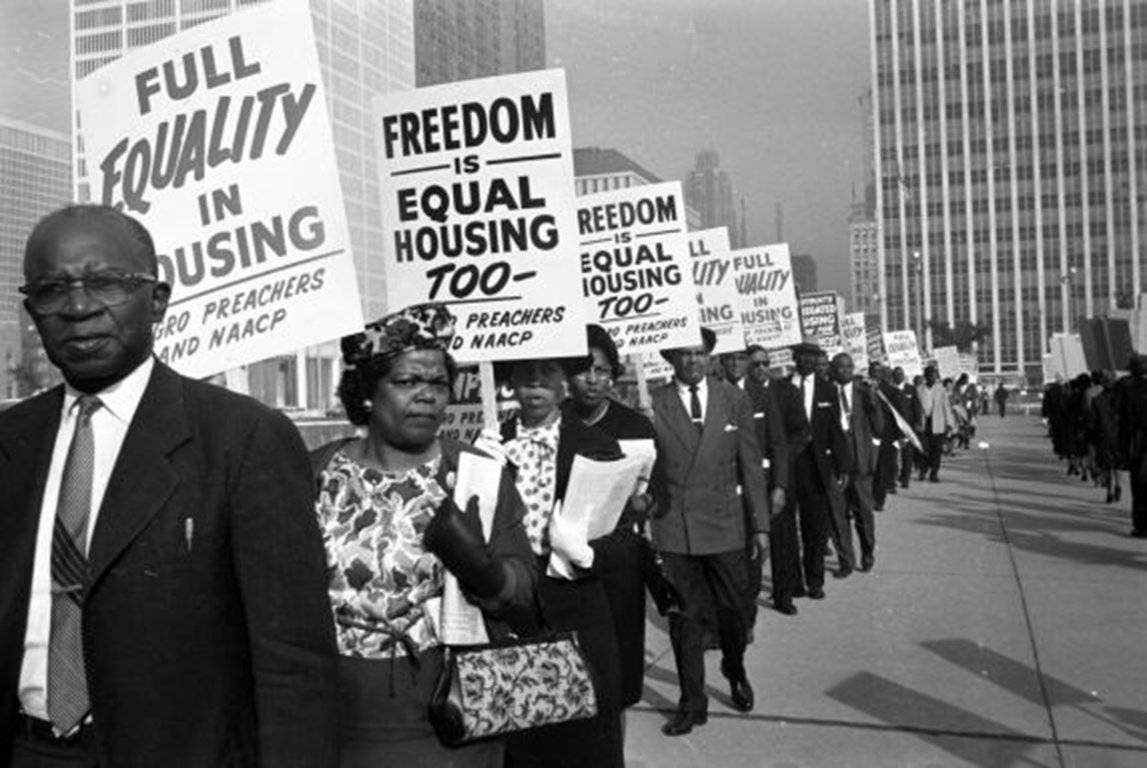
The early 1900s saw a rise in segregation laws, policies, and practices fueled by the Jim Crow era. Minority groups were systematically excluded from specific neighborhoods and denied access to affordable housing options. Redlining, a practice where banks would deny loans or charge higher interest rates based on the racial makeup of a neighborhood, further perpetuated housing discrimination. The Civil Rights Movement of the 1950s and 1960s brought attention to housing discrimination during the fight for equal rights and opportunities. This led to the passing of the Fair Housing Act in 1968, which made it illegal to discriminate based on race, color, religion, sex, or national origin when selling or renting a house.
After World War II, government policies led to the most significant expansion of the American middle class in the nation’s history. This resulted from policies like the GI Bill, which provided veterans with free college education and inexpensive home loans. However, Black veterans were rarely able to take advantage of these policies because of the discriminatory way they were administered. The Federal Housing Administration (FHA) wouldn’t insure home purchases in Black neighborhoods, and Blacks faced hostility if they tried to move into a White suburb.
The impact lingers today because most Black families could not pass intergenerational wealth from generation to generation, like many White families.
In an article, two Harvard Kennedy School faculty, Linda J. Bilmes, a former assistant secretary of the US Department of Commerce, and Cornell William Brooks, former president of the NAACP, wrote about the inequities of the GI Bill:
“The original GI Bill, signed into law in June 1944, was hailed as a transformative measure by President Franklin D. Roosevelt. It provided veterans with loan guarantees for a home mortgage, money for college or vocational school, and unemployment compensation. The bill helped over 4.3 million veterans — mostly Irish, Italian, Polish, Jewish, and other working-class European immigrants — to buy a home.
Between 1944 and 1955, GI Bill mortgages accounted for nearly one-third of all new US home loans, with a present-day value of $340 billion. Nearly 8 million veterans used the education benefits to attend college or vocational school. The bill enabled them to become doctors, dentists, teachers, engineers, accountants, and other professionals, as well as to train as electricians, plumbers, builders, and other skilled trades. As they moved to suburbs, these veterans accumulated wealth, boosted the economy, and drove mid-century American prosperity.
The GI Bill did not explicitly exclude the 1.8 million Black Americans who fought in World War II and Korea. But in practice, the bill’s benefits were almost entirely restricted to whites, making it one of the worst racial injustices of the 20th century.
Members of Congress from Jim Crow states insisted that the law be implemented at the state level. This enabled southern states (home to 79 percent of returning Black veterans) to deny GI benefits to Blacks. In Mississippi, for example, a survey of 13 cities revealed that only two out of 3,229 GI Bill home mortgages went to Black veterans. Moreover, most US cities practiced redlining, in which homes outside certain poor neighborhoods could not be sold, or insured, to Black people. Many lenders refused to lend to Black veterans, even though GI mortgages were guaranteed by the federal government. In New York and northern New Jersey, fewer than 100 of the 67,000 mortgages backed by the GI Bill were granted to non-whites.
Likewise, few Black veterans were able to gain access to the educational benefits of the GI Bill. Southern states barred Black people from attending most colleges, universities, and trade schools. Nearly 95 percent of eligible Black veterans were directed to attend historically black colleges and universities, which were then kept tiny and chronically under-resourced. In 1945, about half of HBCUs had fewer than 250 students; few offered professional degrees. Many skilled trades were open to whites only.
During Black History Month, many school children have read about Dorie Miller, a cook with no military training who shot down several enemy planes at Pearl Harbor. Miller, who became the first Black American to be awarded the Navy Cross, died in combat later in the war. But even if he had survived, he probably would not have received the benefits created for World War II veterans under the GI Bill of
Rights, because he was Black.”
Despite the passing of the Fair Housing Act, housing discrimination still occurs today. It takes many forms, such as denying a mortgage application or charging higher rates to Blacks. Discrimination also exists in the form of higher rent prices and limited affordable housing options for minority groups.
Housing discrimination has a lasting impact on individuals and communities. It can perpetuate poverty and segregation, as well as limit access to quality education and economic opportunities. Discrimination in housing also contributes to health disparities, as certain neighborhoods lack resources for adequate healthcare.
The embedded racial wealth gap in America must be redressed through a comprehensive effort centered on a campaign to provide Black families and individuals with the information they need to make the decisions that can create wealth for them and their families. NAREB’s Building Black Wealth Tour is the vehicle that leads people, young and old, on pathways to financial success.
For more information and for a list of cities that are among NAREB’s Building Black Wealth Tour stops, visit: https://narebblackwealthtour.com.